

Frequently Asked Questions.
TRIC Robotics is transforming pest management through autonomous nighttime robotics and a unique Robot-as-a-Service (RaaS) model. Whether you’rea grower exploring our technology, a partner interested in working with us, or simply curious about autonomous agriculture, you’ll find answers to many of the most common questions below.
Don’t see what you’re looking for? We’d love to hear from you. Contact our team and we’ll be happy to help.
About TRIC
How does TRIC Robotics work?
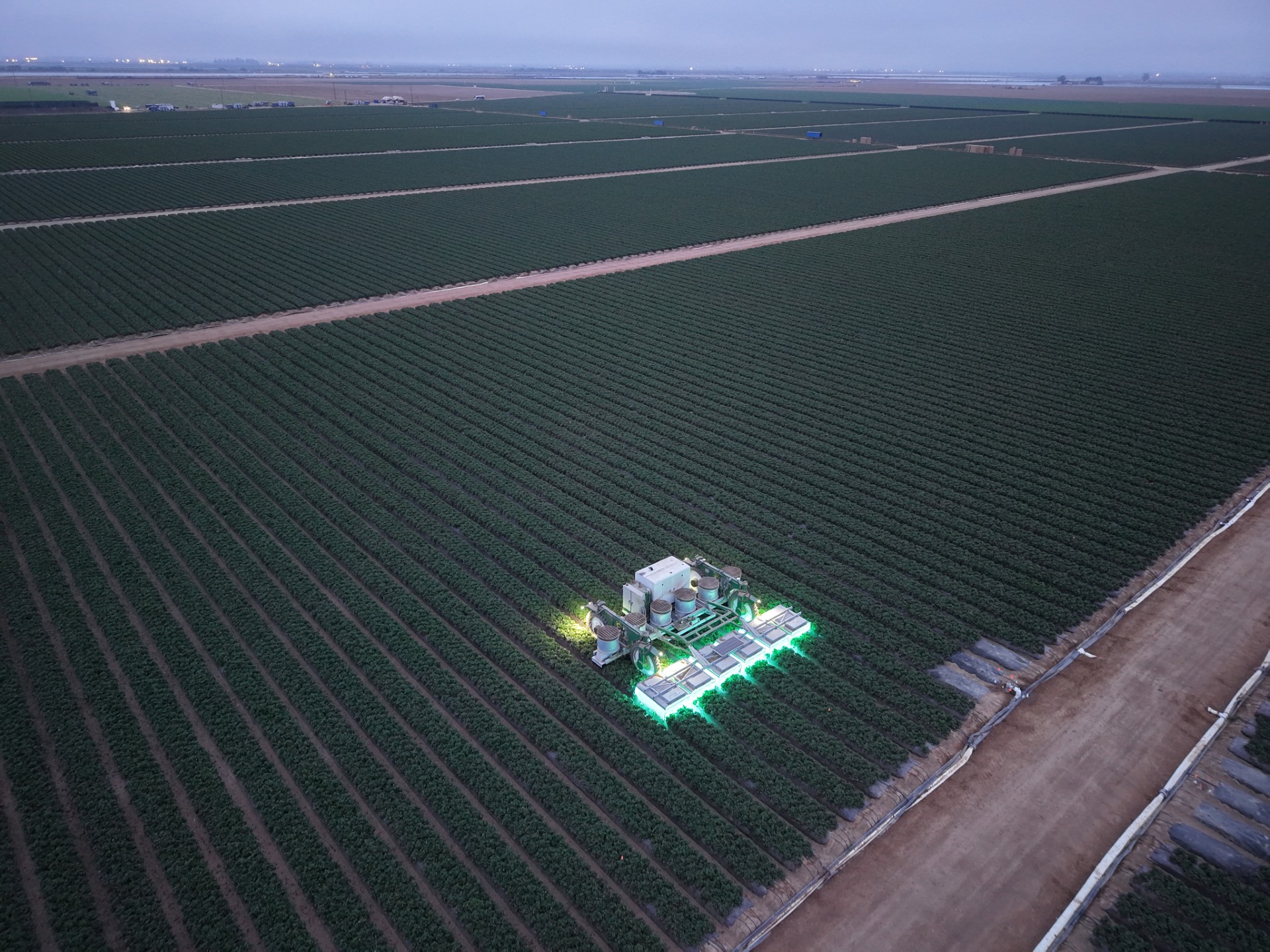
TRIC Robotics provides autonomous nighttime pest management services using advanced robotic platforms equipped with UV-C technology and high-powered insect vacuums. Our robots operate while growers sleep, treating crops with minimal disruption to normal daytime farming operations.
What crops does TRIC currently serve?
Today, TRIC Robotics is focused on commercial strawberry production in California. While the underlying technology has broader agricultural potential, our current commercial operations are dedicated to serving strawberry growers.
Where is TRIC Robotics currently operating?
TRIC Robotics currently provides commercial service throughout California’s major strawberry production regions, including Santa Maria and Oxnard, with planned expansion into the Salinas and Watsonville growing regions in 2027.
When do your robots run in my fields, and what happens if there's bad weather?
Our robots are primarily autonomous, running on a precise schedule tailored to your crop and pest pressure. Treatment is most effective and safely conducted overnight (typically covering 30 acres per robot per night), when the pathogens are most vulnerable. The robots are designed with robust, tractor-scale components to handle real-world field conditions, and our service team adjusts the schedule as necessary to ensure effective treatment delivery throughout the growing season.
Technology
Why do your robots operate at night?
Nighttime operation is essential to the effectiveness of our technology. UV-C treatments are significantly more effective after dark, while operating at night also avoids harvesting activities, farm crews, and beneficial pollinators.
How are your robots powered?
Our robots are powered by an onboard diesel generator, providing reliable electricity throughout the night and enabling extended operation without charging infrastructure or mid-shift battery swaps.
What pests and diseases can TRIC help control?
Our technology has demonstrate deffectiveness against Powdery Mildew, Two-Spotted Spider Mites, Lewis Mites, Lygus Bugs, Spotted Wing Drosophila (SWD), and Botrytis (Gray Mold). As research continues, we are evaluating additional applications to expand the capabilities of our platform.
Is TRIC's technology safe for beneficial insects?
Yes. Because our robots operate at night, they avoid most daytime pollinator activity, including honeybees. Our nighttime operating schedule helps minimize impacts on beneficial insects while delivering effective crop protection.
In addition, independent research conducted by the Cal Poly Strawberry Center found no significant impact on beneficial predatory mites, including Phytoseiulus persimilis (Persimilis), an important natural predator used in integrated pest management (IPM) programs. You can learn more by reading our Lygus & Beneficial Insect Research Case Study. (link to Lygus case study).
Services & Pricing
Can I buy a TRIC robot?
No. TRIC Robotics is a service company, not an equipment manufacturer. We own, maintain, and operate our fleet of autonomous robots, allowing growers to benefit from the technology without the cost, maintenance, staffing, or risk of ownership. Our Robot-as-a-Service model ensures every customer receives the latest hardware, software, and operational expertise as part of the service.
How large of a farm can TRIC service?
Our autonomous fleet is designed to scale with grower needs. Individual robots can treat an average of 30 acres per overnight session. We work with growers to develop service plans based on acreage, crop timing, pest pressure, and seasonal demand.
Each TRIC robot can treat up to 30 acres during a single overnight session. Because most growers schedule treatments three nights per week, a single robot is typically assigned to approximately 90 acres throughout the growing season. For larger operations, multiple robots can be deployed simultaneously, allowing growers to scale coverage across hundreds of acres while maintaining the same consistent treatment schedule.
For Growers
Does TRIC replace pesticide applications?
Our goal is to help growers reduce chemical inputs while maintaining effective crop protection. Many growers use TRIC as part of a broader Integrated Pest Management (IPM) strategy to reduce reliance on conventional pesticide applications.
How can I learn more or schedule a conversation?
We’d love to hear from you. Whether you’re interested in becoming a customer or simply want to learn more about our technology, contact our team to schedule a conversation or request additional information.
LET'S TALK
How many acres can one TRIC robot treat?
Each TRIC robot can treat up to 30 acres during a single overnight session. Because most growers schedule treatments three nights per week, a single robot is typically assigned to approximately 90 acres throughout the growing season. For larger operations, multiple robots can be deployed simultaneously, allowing growers to scale coverage across hundreds of acres while maintaining the same consistent treatment schedule.
LET'S TALK