

Commercial field research validates TRIC autonomous UV-C platforms as an effective mite suppression tool for California strawberries.
Key Sights
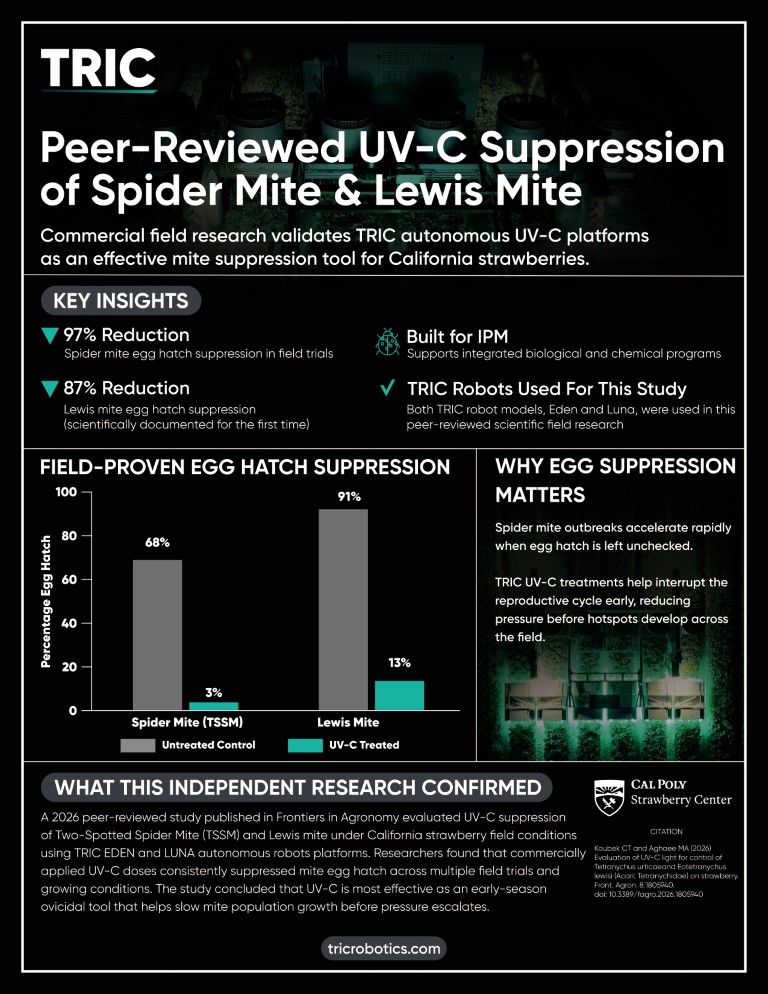
97% Reduction
Spider mite egg hatch suppression in field trials
87% Reduction
Lewis mite egg hatch suppression
(scientifically documented for the first time)
Built for IPM
Supports integrated biological and chemical programs
TRIC Robots Used For This Study
Both TRIC robot models, Eden and Luna, were used in this
peer-reviewed scientific field research
Why Egg Suppression Matters
Spider mite outbreaks accelerate rapidly, when egg hatch is left unchecked.
TRIC UV-C treatments help interrupt the reproductive cycle early, reducing pressure before hotspots develop across the field.
What This Independent Research Confirmed
A 2026 peer-reviewed study published in Frontiers in Agronomy evaluated UV-C suppression of Two-Spotted Spider Mite (TSSM) and Lewis mite under California strawberry field conditions using TRIC EDEN and LUNA autonomous robots platforms. Researchers found that commercially applied UV-C doses consistently suppressed mite egg hatch across multiple field trials and growing conditions. The study concluded that UV-C is most effective as an early-season ovicidal tool that helps slow mite population growth before pressure escalates.
Key Findings from the Published Research
- Commercial field doses consistently suppressed mite egg hatch.
- UV-C efficacy confirmed across multiple growing seasons.
- Lewis mite suppression by UV-C documented for the first time.
- Best fit as an egg-stage suppression strategy within IPM systems.
Operational Aadvantages Observed
- Early-season suppression before outbreaks escalate.
- Reduced reliance on supplemental miticide applications.
- Compatible with commercial IPM programs.
- Supports cleaner, more uniform fields.
- Nighttime autonomous operation reduces daytime field disruption.
- Non-chemical tool for resistance management programs.
Summary Results Table
This published research supports UV-C as an early-season suppression tool that can complement predatory mite and miticide programs when strategically timed within commercial IPM operations.
| Metric | Research Findings |
|---|---|
| Spider Mite Egg Hatch Reduction | 97% Reduction |
| Lewis Mite Egg Hatch Reduction | 87% Reduction |
| Field Validation | Multiple California Seasons |
| Best Fit | Early-Season IPM Suppression |